

the window: an interlude
after Virginia Woolf's To The Lighthouse, written in situ but dispatched upon returning from the lighthouse

‘You can stay until tomorrow,’ said S. ‘You’re the last visitor before I’ll be closing the guesthouse for the winter season.’
The red fog siren trumpet and the clockwork timing mechanism were automated less than one hundred years after the lighthouse had first lit the coastline, as swift as the flare of a match. The engine room was dismantled, parts were donated to the local museum and others were sold. The three keepers and their families, who were made redundant from their work, vacated their respective apartments, which were located inside the two-storey house that tailed the lighthouse tower. Those who came after them were holidaymakers.
‘Ah,’ Guest said calmly. They looked at their watch, which was smart enough to disclose the date, then over S.’s shoulders, onto the silver cliffs outside. The sun was high and the sky chirpy, with the lighthouse lantern looming at the back, a red-faced goldfinch with pretty but obsolete yellow wings now it was trapped inside a cage, which was hooked eighty-seven steps up the vacant tower.
The offer had given Guest the jubilation of an open ending. Although the suggestion had been made as casually as the Gregorian calendar sets a date with the solstice, such an invitation was bound to ease Guest’s stiffed bones as it seemed, after years and years, that an additional night spent swimming under a starless sky, drenched in dark thoughts yet not lightless under the protective aura of the lighthouse, meant morning’s still sea would be within reach. Another night after they had woken up to the tickling heating system warming the bedroom, hot water hissing through the copper pipes, the waves whispering outside the window, which was closed but single-glazed and naked at gale-speed. Guest belonged to the migrating flock of optimists, a timeless disposition for those who cannot not interpret a sign, always letting the future be fantasised by little appearances sprouting everywhere, as all curses begin somewhere, sometime – the black crow lands on the windowsill, the fisherman learns how to swim – which exhilarated their melancholic sorrows otherwise, and since to such wide-winged birds any landing had the power to nest and crack open memories upon which romanticism would feed, Guest, as they stood by the front glass window of the guesthouse, one hand pushing it back as the strong breeze swirled up the staircase of the refurbished keeper’s house, felt pure joy. The red moss growing on the rocks, each head pointing upwards like a rococo Romanesco at the market, eccentric but humbling; the large cobbles, a beach of burnt sand under the drizzling rain, unbelievable and hypnotising; a leftover minestrone was simmering inside the slow-cooker on the kitchen counter, above which the window overlooked another island, if the weather allowed; the jetty where the lighthouse keepers once received goods, which were delivered by sea, a liaison to cook meals of their own before the road was built fifty years ago, where Guest went down the rusty stairs, nearing eight o’clock so the sun had just risen but the tide wasn’t at its highest yet, the sea swelling, its belly growling, swollen by hunger, raging from a fever, emboldened enough to swim; the insomniac’s night being a winter paradise, latent like a shiver of basking sharks passing by, until a fin cut through the water surface and the seagulls fed in a frenzy ahead of them; each supposition had filled Guest with possibilities they could not have fathomed should it had not been daylight, as the teasing sun was always the brightest star after a storm.
‘Take this,’ S had added, handing a plate to Guest, ‘for breakfast.’
Beaten eggs, cubed potatoes, parsley and spinach stirred in, steamed; foresight.
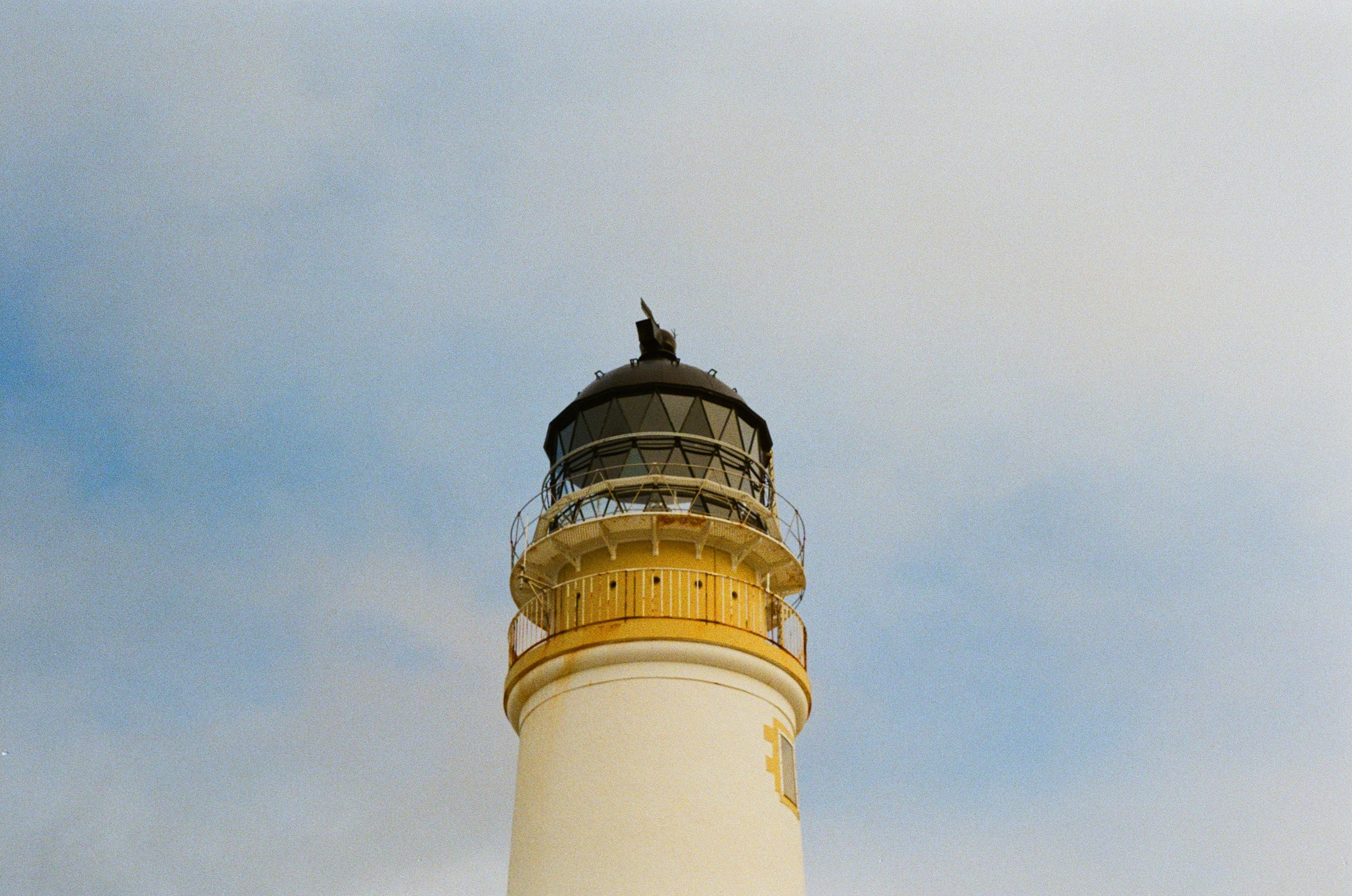
“But what after all is one night? A short space, especially when the darkness dims so soon, and so soon a bird sings, a cock crows, or a faint green quickens, like a turning lead, in the hollow of the wave. Night, however, succeeds to night. The winter holds a pack of them in store and deals them equally, evenly, with indefatigable fingers. They lengthen; they darken. Some of them hold aloft clear planets, plates of brightness.” — To The Lighthouse by Virginia Woolf
The night fell and the lighthouse beamed over the sea below the kitchen. The room had yellow walls and was furnished with feather duck cupboards, plenty of colourful teapots and cups and plates shuffled over the shelves, a real fanfare on a bloody Remembrance Day, a cacophony that was forbidden to dislike as it was warm and nutritious, and welcoming with a large wooden table at the centre. It had been painted in grey, four chairs covered in childish drawings that gave Guest chills as they poured flour inside a bowl. A slow dance with cold air that needed interrupting. They built a summit with their bare hands, then dug a small crater at the top and cracked a first egg inside it, then two, then an extra yolk, the mixture homogeneous and bland, a cold fire as memory became a muscle stabbing them in the back, pushing and kneading the dough, the knife performing their heart, pushing and kneading, panting. Pushing and rolling and pushing, or vice versa, panting and going and going, working a truth first-hand as the recipe, which they had inherited from the grandmother whom they were most fond of, had been theory only.
Guest had potatoes, which they peeled and chopped, and some fresh parsley and a handful of mushrooms, which they chopped, no cream but S. had left a bottle of milk inside the fridge. The heavens outside were pitch dark, nothing else in sight, other than the routine landing of the lighthouse lantern over the lapping waves, until they had opened the window, for that water needed boiling to cook the potatoes, then cool down, then for the tortelli to cook, and the damp inside the kitchen was poisonous, their calves swollen from the water they had soaked up, resentful and impatient, a guest turned greedy for what they could not see no more when the window was blushed with condensation. But the fog called for pragmatism. It could not hide; it hid you. The wind was western, so was that side of the lighthouse, so Guest had to block the window with their elbow for it not to slam back and, there, as they tilted forward, Guest felt clumsy and a little pathetic, in that such a fall from the second floor, flat-headed on to the cement-built terrace, would bring a death as straightforward as the depths of the oceans. It was then, standing vulnerably on the tip of their toes, urging forward then sideways in a manic motion, like a worm transiting through a dry land, or a young’un inside a crowd, stretching their body to see beyond their limitations, that Guest had caught the shadow of otherness inside the mirror of the sea beneath them, then gone as the light spun around the lighthouse tower, and back. A first one rising south, then ahead and further ahead, until a faint gloom beyond the brewing night, so light it was more ashes than fire, still it was a testament of Else. Someone else; elsewhere. Guest had come to the lighthouse to be alone and to experience solitude but, as they woke up the next day and stood in front of the window again, since the sky was indiscernible from the sea, the two as dull and grey as a duet of gentlefolks playing the harmonica at the local carnival, Guest looked again. Behind the belt of the horizon, tucked between what they had projected before – yet another landscape on Earth – small otherscapes poked the offing like warm lips landing on a forehead, a goodnight kiss. Guest had come to the lighthouse to be alone but not to be forgotten, seeking a remote place that glitters among the night to show the way for seafarers and wanderers, but Guest had not been so brave until, as always, the sun scarred the clouds. It was wee and white, although white could never survive on a palette, so titanium perhaps, mixed in with blues or a shade of pink, purple, a lavender field as drew interrupted the night but blocked the day in a tear, anyhow, an opening, something fragrant by the eye, grounding – a landscape to behold future landings, one of plenty windows along a coastline of lighthouses.
margaux
writing notes
This newsletter uses the opening of Virginia Woolf’s 1927 novel, To The Lighthouse, as a departure but was written sitting outside of another lighthouse.


eating notes
Unmeasured, uncertain but not untested recipe for the tortelli di patate referenced in this newsletter:
for the dough: semolina, flour 00, eggs, olive oil and salt
Combine all ingredients in a dough. Form a ball, cover and leave it to rest for thirty minutes. Flatten the dough with the help of a rolling pin, then pass it through a pasta machine until you’ll reach the thickness of your choice. Cut the dough into squares.
for the filling: potatoes (peeled and boiled), parsley, egg white
In a mixing bowl, combine the potatoes and the parsley. You can use some egg whites to make the mixture hold together. Season with salt and pepper to your taste. Leave aside but keep it chill.
for the sauce: white onion, chestnut mushrooms, sorrel, oat cream
In a pan, gently fry the onion with some olive oil. Add the mushrooms, cook. Reduce the heat. Add the oat cream and leave the sauce to simmer on a low heat.
to assemble the pasta:
Drop a tear of filling at the centre of each square of dough. Fold the pasta into a triangle, then twist and join the two bottom extremities together. Keep going until you don’t have neither filling nor pasta dough left.
then, a meal:
Boil some water. Cook the tortelli. Throw a dollop of cooking water in the sauce, then drain the pasta. Stir the tortelli into the sauce and mix. Turn the heat off; add the sorrel, mix. Serve.
thank you for reading The Onion Papers. i’m margaux, a writer adrift, and this is my hybrid newsletter where i read and wander to meet friends and cook to feast with new pals. if you enjoy my work, remember to subscribe and/or invite friends to the party as you keep me going. read more about TOP here.
PS. i write novels too.

the garden that didn’t flower: on symptoms

Last spring, on a brilliant day, I chose a fig tree. Its leaves struck me with the flux of a swimmer’s hands breaking through water, and I chased the fantasy of holding a fruit I would have witnessed mature inside the palm of my hand. I paid for it swiftly, contactless, and brought the fig tree home. I painted a lighthouse on a large terracotta pot and …