

July Peels (2026)
sticky and green, honestly humid, smelly but in search of lost time and poetry and pals. and a new short story called The Whistleblower.

hi, and welcome to The Onion Papers. Peels are a writer’s almanac featuring bread, soil, reading, kitchen and sky updates, and are published on the first Monday of each month. i’m so happy you’ve joined us.

Coucou, you. May I tell you about the cuckoo spit on the heather? That is, a white, frothy foam created by the immature nymph of the froghopper insect, a summertime spider web that takes its name after the cuckoo birds who had tuned in at the end of spring. The geranium has flowered like Mamie’s kiss on my cheek, a bright pink lipstick, and there is enough sage to feed the entire building. Recipe swaps are my favourite form of correspondence. Waking up at six in the morning to prepare tiramisú for friends is my love language. Stop and start; windy linens drying in the communal garden; stop stop stop. July in my corner of the world has been wet, a tidal summer of Scottish spells endured dressed in fleece while watching France burn remotely. How does one grieve a landscape? I dream of a Bougainville climbing up the wall. I snack and spit cherries while walking the dog in honour of old friends, ever since I learnt that Cesare Pavese ‘loved the first cherries, the ones that were small and watery,’ as Natalia Ginzburg wrote in Family Lexicon, ‘and he’d say they “tasted like heaven”. From the window, we’d see him appear at the end of the street, tall, with his swift stride, eating cherries and spitting the pits against the walls, his shots lightning-fast and exact. For me, the fall of France would forever be associated with those cherries which, when Pavese arrived, he made us all try, pulling them one by one from his pocket with his parsimonious and grumpy hand.’ As for me, I raise an arthritis-ridden hand so I may sip Armagnac while moonbathing. I take my cup of coffee to the public bench, make helicopters land by splitting maple samaras in two, all the while wise reasons for sunny phone calls with present pals, caffeinated and feeling fierce. It was avant-garde poet and playwright Apollinaire who had reminded me to lose, ‘mais perdre vraiment’, so as to allow for a real loss that would leave enough room for new encounters to appear. He did, so I have tried to read one poem a day, memorise a few, versing a riddle for a cheeky date with myself. Marvellous memories but pragmatic L. propagated the santoreggia in anticipation of next year’s appetite. The first sunset to fall before 10pm crushed us on a Sunday. The date was July 12th, Judas’ day. Then, eventually, ferries and faeries, for my sense of relief is a small island. Oystercatchers flirting in my ears, blanched limpets and crab claws crackling under my feet, finding new ways of seeing while kneeling clumsily on a cliff with binoculars. Kittiwakes and guillemots, be stunned by the lyrics of chicks flying off, time passing but Leopoldo’s paws earmarking our passage on the causeway to tidal Oronsay. More rain as it battered the canvas of a tent; the auditory experience is like seeing through the glass of a diving mask, a forced delay that invites a compassionate look, listening to look. Happy swimmers snorkelling around the inner Hebridean island of Colonsay, a green rocky dot, like a mossy bell at the top of an abandoned church. My poetry may be my curse but please will you dance with me?


bread update
Melancholic baker friends cheer up as neuroscientists from the CRNL in Lyon have confirmed that Marcel Proust hadn’t lost the plot! There is a madeleine somewhere in your life too.
‘No sooner had the warm liquid mixed with the crumbs touched my palate than a shudder ran through me and I stopped, intent upon the extraordinary thing that was happening to me. An exquisite pleasure had invaded my senses, something isolated, detached, with no suggestion of its origin. [. . .] Whence did it come? What did it mean? How could I seize and apprehend it?’
Well, In Search of Lost Time, and in an olfactive “bulb” located in your brain indeed. According to this research published in Plos Biology (relayed in Liberation), a positive early-life olfactory memory can trigger large-scale changes beyond the olfactory system and show up later in life so:
‘suddenly the memory revealed itself. The taste was that of the little piece of madeleine which on Sunday mornings at Combray (because on those mornings I did not go out before mass), when I went to say good morning to her in her bedroom, my aunt Léonie used to give me, dipping it first in her own cup of tea or tisane. The sight of the little madeleine had recalled nothing to my mind before I tasted it. And all from my cup of tea.’
This month I also baked my first sourdough loaf in the new oven, for which memory was a sly ally but the hydration ratio was 70%, as follows:
8:16am – 58g of rye starter; 42g of white flour; 50g of lukewarm water – mix the levain, cover and set aside
2:37pm – above-mentioned levain; 200g of wholemeal flour; 200g of eight grains flour; 280g water – mix with a Danish whisk first, then knead with your hands and form a tight dough ball; cover with a kitchen towel and set aside
4:18pm – first knead
5:32pm – second knead
6:37pm – third knead – sprinkle flour on top, cover with a lid and set aside in the fridge for an overnight proof
7:22am – transfer the dough ball on a working surface; shape it and cover with an upside-down bowl
8:55am – score the dough; bake for 30 minutes at 240C , then 20 minutes at 220C


reading, listening
Let me start by addressing the elephant in the room. On the topic of The Odyssey, I have one response only: read the book. It’s gay! Poetic, threaded, timely and fizzy. It’s great.
[And you’ll know from a past newsletter that I’m an Iliad baby. Either way, I am not that original and recommend Emily Wilson’s translations, if you are after English versions.]
Now, Sarah Waters’ Tipping the Velvet is where the real fun began for me this month. Nan King be my heart in this sensuous, delirious story of a Whitstable oyster girl turned music-hall star in Victorian London. It is erotic, picturesque and confident with descriptions, a real road show for the armchair travellers.
Then Mother Mary Comes to Me by Arundhati Roy. This is a memoir about Roy’s relationship with her singular mother, Mary, ‘my shelter and my storm’, and this is about the making of a writer foremost. It has a rare honesty for it speaks about love furiously, and more so about language:
‘Language that I used, not language that used me. A language in which I could describe my multilingual world to myself. I knew even then that language was outside me, not inside me. I knew it would not come to me on its own. I needed to hunt it down like prey. Disembowel it, eat it. And when I did, I knew that language, my language, would ease the way blood flowed through my body. It was out there somewhere, a live language-animal, a striped and spotted thing, grazing, waiting for me-the predator. That was the law of my jungle. It wasn’t a non-violent, vegetarian dream.’
I received Mother Mary Comes to Me as a generous gift from a novelist I have long admired but not always understood.
Still in non-fiction but in audiobook, I listened to Don’t Forget We’re Here by Lamorna Ash. After noticing that several of her friends are turning to faith, Lamorna Ash sets out on a journey across Britain to meet young people who are rediscovering Christianity today. This is journalism as I like it – so riddled with imperfect humanity – opinionated but not forceful. It is filled with encounters, some challenging and others illuminating, that have invited me to think about faith from a different angle. And to keep on thinking.
Also, I recommend wearing cargo trousers so you may keep a hefty copy of Herman Melville’s Moby-Dick in your pocket, read it on the go, twice in a row, oops but oh so thrilled from reading it in English for the first time. It is so tactile, tender! queer. I am itching to say more about this so be teased for now.
in the kitchen:
Unseasonal advice first: one teaspoon of red miso for the minestrone. Otherwise, barley salad season is back. Black olives and anchovies; there can never be enough sea salt. Crunchy celery! Creamy broad beans. Peach peach peach, yellow plums. Soak the wholemeal couscous in crayfish broth. Capers and garlic and oregano. Sage and red onion and paprika. The secret of any slow-cooked pot hides in the battuto, which is where variations for a meal you may have cooked on repeat before reside. Improvised börek compositions to use the leftover filo pastry: tinned sardines and white onions; red pepper, paprika and spinach; parsley, egg and tinned tuna.
Orzo eaten in July shall be red. Late night salmon and asparagus farfalle for those who had wished to keep on dancing. Mezzelune alla pantesca to share over lunch with friends. The accompanying ammogghiu is tomatoey and uncooked, oily, but with a bite, a pesto crushed to honour a volcanic island that stole my heart a couple of summers ago – Pantelleria, where capers are matured in salt instead of brine, or tomatoes, garlic, parsley, oregano, capers and olive oil hugging me under the crescent moon.
for the ammogghiu, aka pesto Pantesco:
ripe tomatoes (grilled, peeled and cored)
garlic cloves, peeled
parsley, stems removed
peperoncino
oregano
capers
olive oil
Start with grilling the tomatoes. Let them cool then peel them. Remove the seeds and placenta, and cut the tomatoes roughly and leave aside. In a mortar, crush the garlic, parsley, peperoncino and capers. In a bowl, crush the tomatoes with a fork (keep some bits). Incorporate the parsley, garlic, peperoncino and capers paste and mix thoroughly with a wooden spoon. Add a generous amount of olive oil as you mix. Season with salt and pepper. Cover the bowl and store the pesto away to chill in the fridge – it will gain in flavour while you make the pasta. This pesto is served raw and cold.
PS. Mint, lemon zest and ricotta for the pasta filling. Eggy dough for folding’s ease.
About the tiramisú mentioned above. Turns out the Internet is filled with good suggestions if you are after a recipe for a lactose-free mascarpone. For the rest, this is how I approached 6 individual portions in Duralex glasses:
200ml strong coffee
2tbsps rye whisky
3 large eggs
100g brown sugar
60ml Estonian rum liqueur (I used Vana Tallinn)
250g mascarpone
12 Savoirdi sponge fingers (approx. 2 biscuits per pot)
Cocoa powder
Prepare the coffee. Stir in 50ml of cold water and the brandy. Leave aside.
In two large bowls, separate the egg yolks from their whites. Whisk the egg whites until they will start to stiffen. Add 50g of the sugar and keep whisking until the mixture is firm. Set aside. Now whisk the yolks with the other 50g of sugar. Keep whisking, add the rum liqueur, and keep whisking for a good five minutes. Add the mascarpone gradually, whisking and whisking for another five minutes. Using a wooden spoon this time, gently fold the egg whites into the yolks. Don’t beat them but work your way circularly from bottom to top, then sides to the centre, round the clock again. The mixture is ready.
Time to assemble the tiramisú pots. I make them in pairs. Dip a first sponge finger biscuit in the coffee mixture, so it is wet but not drenched. Place one half at the bottom of each pot. Spoon 2 tablespoons of the mascarpone cream in each pot, then place another half biscuit on top. Sprinkle some cocoa powder. Dip two sponge biscuits in the coffee mixture. Break them in two and place two halves in each pot. Top up with another tablespoon of the mascarpone cream. Repeat this process three times, so you will have six pots in total. Cover the pots with cling film and chill in the fridge for at least six hours, though anywhere between ten hours to overnight is prime time. Sprinkle extra cocoa powder before serving.


In the away-kitchen, plenty of no fuss cooking delights brought by mixing a little tin of beans with some passata on the side of a hiking path, breaking the stale rye bread in the soup, crumbs soaked and revived, or the thickness of a chickpea stew that has simmered over a camping stove against the gale. Pre-cooked rice bags for the salads, and herring in pepper sauce and sun-dried tomatoes and artichokes and olives. Home-baked tuna loaf, always since it fits in pockets. Boiled eggs and smoked salmon because wanderers take breakfast seriously; an absurd amount of complaints about instant coffee, and, what if, if only, dinner perks up from a snorkelling adventure? Not one shell a reliable Opinel knife can’t handle.
from the Onion Papers:
Nothing from The Onion Papers this month but in response to the recipe for mezzelune alla pantesca pasta, a reshare from the archives. Two newsletters about Pantelleria:
Dancing with Medusa in Pantelleria

Mornings in Pantelleria have a timing of their own, the air thick like breath yet we wake up breathless. I brew large pots of coffee to share with Ludo and to see us through the fog of our brains. We sit outside. Our terrace is overseeing the port where the lorries that bring goods to the island are boarding the morning ferry. It’ll leave for Sicily soo…
Cucina Pantesca

You’re walking next to me. I want to be reassuring when I say that the road is short, but uphill. I catch you squinting your eyes and I acknowledge that it’s amazing to see rosemary plants grow in unexpected places like that. Green needles pop between rocks, I smile. My skin is stretched, salt crystals snow over my eyebrows; you pick a wild fennel stem …
/
And a new short story! In July 2024 I visited Hernaness, a national nature reserve and RSPB centre, where I had, for no better words, a transformative experience looking at gannets. I sat hour after hour, still for hours, as the gannets danced in a frenzy before me. This is the story behind my latest short story, The Whistleblower, which was published in the Feminist Food Journal x Chlorophyll ‘architecture of food’ issue, and whose magical realism, I’m afraid, feels more real than magical amidst this month of heatwaves and wild fires.
On a western island lived a woman who was said to be older than anyone else. She walked on the balls of her feet, and her hair was as long as she was tall, dyed in green. She spoke in lullabies. She was a healer and a sea forager, grilling clams and oysters for her supper, painting their shells, which she crafted into jewellery before selling the wearables at the weekly market. She was a cold fire whom the islanders had nicknamed Mum. She bothered folks with her unkempt appearance and her memory that never forgot; she was notoriously unforgiving, but she was loved. Mum was good fortune.
looking ahead (Glasgow, GMT)
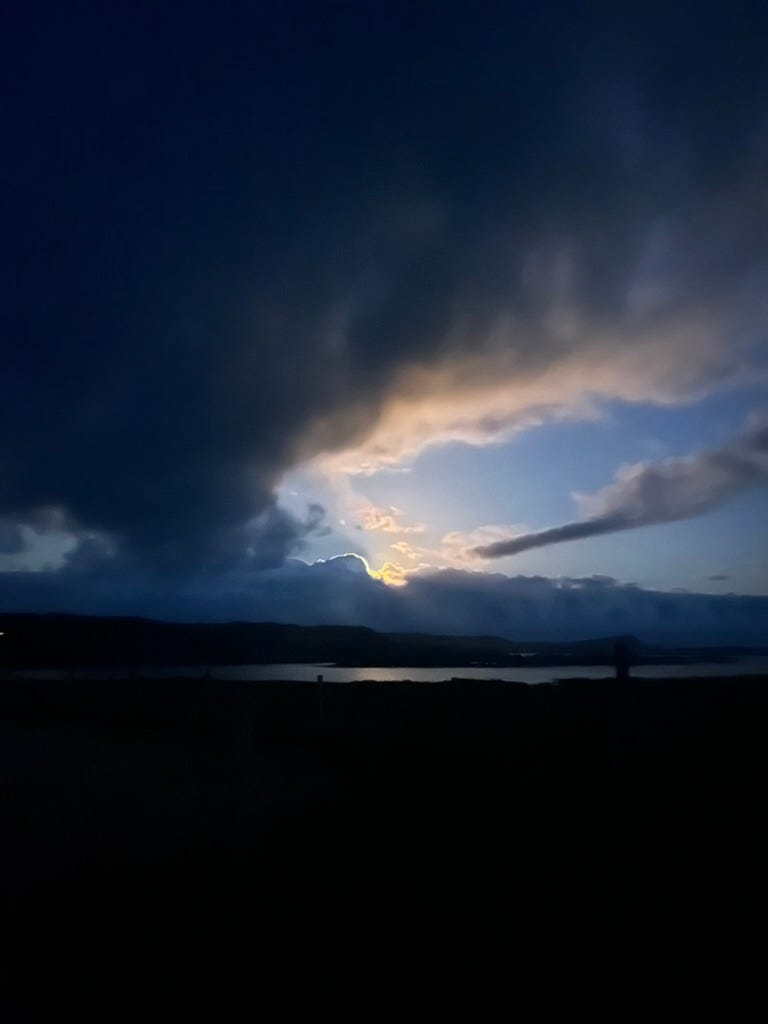
The hills are heathery and mossy, the kitchen table is dressed in gold, sunflowers standing dutifully like lighthouse keepers inside a long and thin vase. If I was told that a dry first week in August brings a harsh winter, I already knew that I should smell the butt of a melon before halving it. And crumble some pistachio nuts on top, fresh torn mint or basil leaves, my nails burgundy with dry blood since the hand-held mandoline slicer isn’t safe enough and August brings far too many distractions. The seagulls are learning to fly, the ducklings to swim, and the cuckoo offsprings too are flying away. Venus will be visible again from mid-August but the moon won’t be full until August 28th. This is the last call for sunsets before autumn, the great season of the sun rising, begins, and I am here rolling grilled aubergines involtini for lunch, hissing; snacking on radishes, crunching; frying sage leaves for aperitivo, crisping; roasting a tajine for dinner, cuddling. Here I am, so are you, rising and rising at the very edge of a stinky summer that shan’t be forgotten because there are plenty of us, but there only is one extraordinary Earth.
margaux
thank you for reading The Onion Papers. i’m margaux, a writer adrift, and this is my hybrid newsletter. if you enjoy my work, remember to subscribe and/or invite friends to the party as you keep me going. read more about TOP here.
PS. I write novels too.
Shedding a tear or three at this beauty❤️